Showing posts with label language arts. Show all posts

Tuesday, February 26, 2019

Necessary Changes

Every year for the past 4 years of our home schooling life I get off track after Term 1 exams. This year it started just before exams. I decided to roll with the punches and make some changes. We really need a more open and go, low prep plan right now. 

"Roll with the punches" Have you ever wondered where that idiom came from?? It's a move used in martial arts. We use it to refer to how we adapt to setbacks in order to better manage their impact on our lives.  So, I made some changes, during this season of our lives.

For one, I revamped our Language Arts. I incorporated a spelling workbook, dropped copywork and dictation, and picked up Rod and Staff for our grammar.
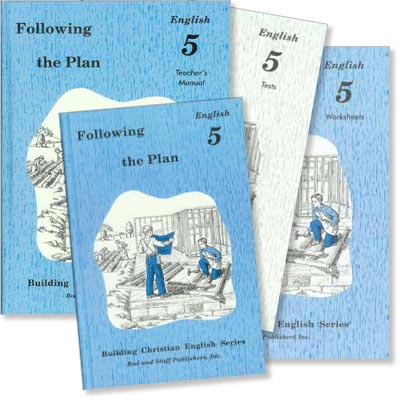
My priority was a teacher's guide and Rod and Staff has a well laid out one. There isn't much prep required, the lesson material is easy to present, and it can be presented in an living way. I sit with my student and we go over the lesson. When we first started I only did the oral drill section. On our term exams though, I found my 4th grader hadn't retained very much and he didn't understand or follow the printed directions. So, now we do just 3 or 4 of the written exercises too.

My 7th grader prefers this curriculum over her Analytical Grammar that she was doing. Rod and Staff seems to break it down for her in easier to digest pieces. I started in Book 5 but then backed her up to Book 4 because that's where Rod and Staff actually begins diagramming sentences. The course only progresses through 10th grade but in Cathy Duffy's review she states the program is thorough and complete. 
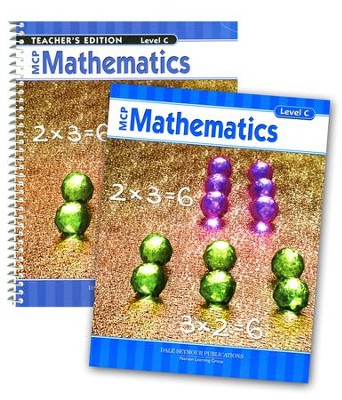
I also switched our "living" math to a curriculum. I wasn't doing such a hot job preparing the "living" lessons. Many times problems needed to be worked ahead of time and a lot of times I got those wrong. I wasn't comfortable teaching without a structured format and my children were getting frustrated with my own confusion over how to solve problems. I intended to return to Math Mammoth which we owned and used previously, but the flow of the lessons, the intermittent use of common core standards and lack of a teacher's guide turned me off. I searched through Cathy Duffy's reviews on math curriculum and found MCP Math.

MCP Mathematics Level C, Grade 3, 2005 Ed., Homeschool Kit   -
Cathy's description of the teacher's manual sold me instantly..
I sometimes use the MCP Mathematics teacher’s edition as an example of what a good teacher’s manual should look like. [...]

"I really appreciate this format where everything you might need is visible on a two-page spread. It is easy to pick out what you might want to use so lesson preparation time is minimal." cathyduffyreviews.com. 

Apparently one of the drawbacks to this curriculum is its lack of review and slow pace. Well I have Richele Baburina to thank for teaching me how to use the method of New, Review, and Mental math. It's a part of teaching math the living way.


There are plenty of problems in each section, more than could or should be done in one setting. I use the teacher's guide to "teach" the new part. I sit with my student as we work through the first few together. I then assign a few problems in the book for the student to work on independently.
I flag pages with a post it note that have problems I want to return to later for review, these problems are presented after their independent work is completed. In the teacher's manual there is a section on every page for warm-up, mental and review math. I use these exercises as a part of review or mental math. All in all, we spend about 30 minutes on math keeping the lessons short. 15 minutes on new, 10 minutes on review and the last 5 minutes on mental math. Lessons are still short and end on a lively note.

In spite of it being a curriculum, I'm still attempting to keep it lively and interesting. The kids seem to like it and they really like the fact I "look" like I know what I'm talking about.

I made a few other changes too, like dropping Spanish and Spanish folksong. I don't speak a foreign language and its been difficult for the children to pick up without any "immersion". I decided to hold off on Plutarch this year and I'm taking to the kids to an outside art class since that was always pushed to the back burner.

So there you go, our necessary changes to make this season more manageable. 

**updated planner pages uploaded under "Printables" tab

Tuesday, January 9, 2018

Charlotte Mason Grammar & Composition

Most times, when something isn't working in our home its because the directions weren't followed. The same holds true for following Charlotte Mason. I'm constantly fighting my tendencies to return to and follow a system. Most recently I caught myself panicking about my daughters lack of composition skills. Her lack wasn't because of Charlotte's method though! It was my misunderstanding, my lack of knowledge, in how to implement language arts according to her method.

After digging in I've realized not only have I not been consistent in some important areas, I've also not been doing them correctly!! Here's my plan to correctly implement Miss Mason's method.  

As my daughter is in Form II, we will continue with her copywork, oral narrations after every reading, short grammar lessons, and more frequent written narrations. 

Oral narration teaches her to order her thoughts. It's basically a retelling of what she has read. She does this after all her readings. 

Copywork and dictation teaches spelling in context and sentence structure. We haven't done well in either of these areas. For copywork, I've always handed her the book and told her to copy a particular passage. She would look back and forth copying the passage down. That is not Charlotte Mason's idea of copywork! 

We are to train our children to look at the whole word or passage (depending on age and skill) and then practice viewing it with the minds eye (eyes shut). Once the child can visualize the word or passage, they write it in their copywork notebook from memory. This takes practice and should progress slowly beginning with words and building up to phrases. 

Dictation is the next step and usually started in Form II. I usually let my daughter pick the passage from one of her current lesson books, study it for punctuation and words she might misspell. When she felt ready I would select a sentence from the passage and dictate it. Again, not exactly what Charlotte had in mind. 

Liz, in the ADE podcast, suggested choosing a book that is below the child's ability to read for dictation. We will choose one that she is familiar with from a previous year. We will start over and begin with sentences, moving on to small paragraphs. Then multiple paragraphs and eventually selecting pages for dictation will happen in later years. 

We haven't been practicing visualization so we will start that training and I will have my daughter study the passage for punctuation and spelling issues. When she is ready, all study helps are put away and I will dictate the selection phrase by phrase, a few words at a time. We mustn't repeat and if there are three errors we will stop the dictation. Charlotte tells us not to allow the child to see the misspelled words. So I will turn the paper over and provide the correct spellings. Most importantly, I will let her know that dictation is not a test. 

Written narration is supposed to start around the same time as dictation. I recently found out that its in written narration she finds her own voice and learns the mechanics of composition. More on written narration in an upcoming post!

This entire process is a relaxed and natural progression. It has an end in sight. This is a part of Charlotte Mason's method of education.

Here, is a great visual video chart from Sonya Schafer that sums up and walks you through the way Charlotte Mason taught language arts as a natural progression.


I have found A Delectable Education's advice to be very true to Charlotte Mason's writings. They have a few podcasts that address Language Arts and I've found this one most helpful  Episode 48, "Writing: Copywork, Dictation & Written Narration"