Saturday, August 31, 2019

Our 2019-2020 School Year Plan 5th & 8th Grade

We are 5 weeks into our school year and I'm hoping it's safe to post this! We always end up tweaking things as we realize what works and what doesn't. We have made changes already this year but this should be our final plan. We have such a great time so far!

This year we have a 5th and 8th grader! It is time to buckle down and get our 8th grader ready for high school. This year she will learn the skill of note taking, studying and taking a test. She will also work on the mechanics of writing papers and continue working through her Pre-Algebra course. Our 5th grader's goals include improving spelling, progressing in math and improving his writing dexterity.

I also wanted to keep them both together as much as possible in order to keep things simpler. I will show you below how we did it. So here's the plan.


BIBLE (together)
  • 10 min  Bible  4x/wk
  • 15 min  What Every Christian Ought to Know 4x/wk
  • 15 min  Trial and Triumph 4x/wk
The kids requested we continue Bible study as a group. My oldest reads her devotional before bed, my youngest isn't there yet. He would if I pushed but I really want that to be a personal choice for him. Our church is following the Gospel Project in Sunday school and that's what we are following at home. We read the selections throughout the week along with the Scripture from their Sunday school books. It's made for some wonderful discussions at home and church.

We are also reading "What Every Christian Ought to Know" by Adrian Rogers. The kids enjoy his writing style and it teaches key points of doctrine.

On Friday's we don't read Adrian Rogers, instead, we read a short missionary biography from Trial and Triumph. The book is laid out chronologically so we started in the last section for our "modern" time period.

HISTORY (together)
  • 30-60 min  America's Story/Civil War Study  5x/wk
  • 30 min       Historical Biography/Fiction read  1-2x/wk
Originally, we planned to stick with 3 history streams; American, World and Ancient. After looking ahead to our 8th grader's high school plan, we decided to change course. We are only doing American history (1861- present) this year. If we can get it all in, the plan is to study the Civil War in depth and work our way toward today. It's a lot of ground to cover but I like the way Angela O'Dell has it all laid out in her history series, America's Story. We still read aloud together as a family, the kids still narrate and then they have their individual historical biography/fiction books they also narrate. I'm debating whether or not to add some type of writing component for my 8th grader later in the year. 

The Civil War is an important part of our Southern history and its important to us that it is taught in an objective and accurate way. We found a wonderfully detailed unit study from Homeschool in the Woods specifically about the Civil War. We don't do all the projects because they require a lot more time than we have. Since we are a military family, the kids have really enjoyed the "military" projects. We usually do all the copywork, labeling of maps and timeline. 

We also chose some books off of Guest Hollow's American History list to read as a spine, specifically for the Civil War. Once we are past the Civil War, America's Story texts will be our spine.

SCIENCE/NATURE STUDY (together)
  • 30-45 min Curriculum  4x/wk
  • 30-45 min Nature Study  1x/wk
  • 30 min Science Biography/Reader  1x/wk
  • 30 min Special Studies Reader  1x/wk
God's Design for Science from Master Books is geared for grades 3rd - 8th and since I'm all about simple this year, we decided Olivia could participate as well. She completes the "challenge" sections, experiments with lab reports and takes the exams to ensure she is getting what she needs. 
**Curriculum Update** We stopped using God's Design after completing a term of Chemistry. The lessons were to short and dense for the information being taught. My students were unable to retain the material. They loved the experiments but I wanted them to understand and retain the concepts. We switched my youngest to ABeka Science and my oldest is reading through the John Hudson Tiner series with added supplements. You can find information on her schedule here at Middle School Science. 
As I pointed out in earlier posts, most of her science would fall under a general science scope. This year I wanted her to focus on physical science using Apologia. When viewing the curriculum my science loving girl was rather deflated. So, in order to "fit in" the physical science portion she is going to read Joseph Tiner's "Exploring the World of Physics" book. It's a short but dense book with only 14 units. We are scheduling it once a week (in place of her special study) over her 2nd and 3rd terms.

Speaking of Special Studies, it's a Charlotte Mason thing. Many CM websites have cycles you can follow as the studies rotate over the course of the student's schooling. These are side subjects in addition to their regular science that the student can learn more about. This year my 8th grader is studying mold, yeast, bacteria and hibernation this year. My 5th grader is studying cultivated crops and mammals. This just means we pick up some living books on those topics and allow the children to read through them, narrate and if they can observe in nature.

Nature study, for the longest time, was very inconsistent. I decided to schedule it just once a week and find some sort of "curriculum" to help guide us through it. I went ahead and paid for a membership with Outdoor Hour Challenges and so far it's really paid off. I get a weekly email to keep me on track with what we are studying. The kids are notebooking all their subjects now and Handbook of Nature Study website has loads of printables for their members. 

GEOGRAPHY (together)
  • 30 min Living Books 3x/wk
Realizing my children my children had major learning gaps in physical geography, I pulled together a course to fill in those gaps. I linked it below. This year we will finish up with that plan (physical geography/earth science) and move right into people and places (human/cultural geography).

I'm still undecided about Guest Hollow. I think the book choices aren't what they could be for my older than intended students of this curriculum. Master Books has made reference to a surprise geography something in the works in one of their FB videos but I'm not sure if its physical, cultural or what. Plus, I don't know if it will be out in time.

I have found some great supplemental resources; videos, posters, teaching aides, and such. I will link below.

Physical:
  Earth Science: finish out our program

People/Places:  
 Guest Hollow Jr. Geography (parts of)


PBS Series: Families of the World 
I'm hoping to find these at the library! The whole set can be purchased online but its pricey! They even offer teacher's guides. If you provide your email, they will give you a guide for each video. The guides could almost stand alone, they provide great information such as a copy of the script itself, discussion questions, tests and answers. They provide information about the land, climate, plants and animals. They address the culture and history of the people too.

ENRICHMENT (together)
  • Folk song, Art, Hymn, Composer 10 min 4x/wk
  • Shakespeare 30 min 1x/wk
  • Drawing 40 min 1x/wk
This year we picked our composer, artist, hymn and folk song to coincide with out time period. One Shakespeare play per term. We also focus on folk songs and hymns one per term. That gives the children time to learn them. We change our art prints and composer's music every two weeks.

For drawing, I purchased the drawing course, Living Art Lesson from Master Books. It should be in sometime this month!


5th Grade5th GRADE 

Language Arts 
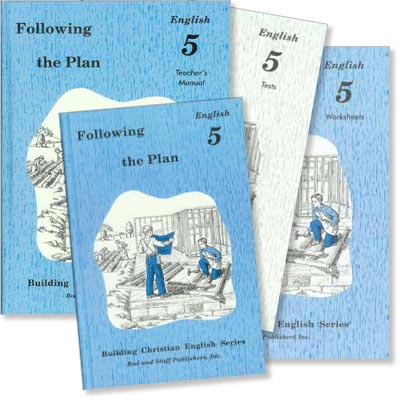
Rod and Staff for Grammar  30 min  5x/wk
Spelling You See 15 min  5x/wk

Mathematics
MCP Mathematics 30 min  5x/wk

Geography (Physical/Map work)
Beautiful Feet's Tree in the Trail, Minn of the Mississippi, Seabird 1x/wk
      
Readers/Biographies
Literature Classic 1x/wk
Literature Free Read 1x/wk
Science Biography 1x/wk
Special Study 1x/wk

8th Grade8th GRADE

Language Arts
Jensen's Grammar workbook/DVD 5x/wk 
Getting Started with Middle School Sentence Composing by Killgallon 1x/wk
Rod and Staff Level 8 (writing sections only) 1x/wk
**Update**
ACE Ministries English Paces

Mathematics
Math Mammoth Pre-Algebra 5x/wk
Jacobs Algebra if finishes with Math Mammoth
Algebra 1: Expressions, Equations, and Applications by Paul Foerster alongside David Chandler's Home Study Companion

Geography
Book of Marvels by Halliburton 1x/wk
Current Events 1x/wk
Map Work

Citizenship
Young Citizens Reader pgs. 1-135 1x/wk
(7th grade: 1-68, 8th grade: 69-135, 9th grade 135- end)

Readers/Biographies
Literature Classic 1x/wk
Literature Free Read 1x/wk
Science Biography 1x/wk
Special Study 1x/wk             

Wednesday, August 28, 2019

Apologia Science was a Bust!

I worked so hard on our Apologia plans, then I showed them to my oldest. She was excited, at first.

After watching the first video it became obvious this wasn't going to work. I thought the videos were great but she couldn't keep up. Even after reading the text, she wasn't enthused. So back to the drawing board I went.

Also, in light of my mother's impending surgery, I realized we really needed a lighter school year. So, I started trimming things from the schedule, seeking out ways to combine them both, and looking for a more open and go approach. That's when I found Master Books!

masterbooks.com - Where Faith GrowsMaster Books has a Charlotte Mason "flavor" to it but it's all contained within these well written texts WITH teacher's guides!! I so need teacher's guides. We are 5 weeks in and it has been a total game changer. I'll have an updated plan posted soon!

Thursday, June 20, 2019

Our Apologia 1st Edition Lesson Plans

I finally laid out my 8th graders Physical Science plans. I planned on making a bound journal similar to what they offer now for the 2nd edition but it didn't work out. Our objective for the journal isn't busy work, instead we want it to teach her how to take notes and learn study skills.

So, instead I've decided to get a binder and divide it into the 16 modules of the book. Under each module she will place the assignments for that section.

Front of Binder
Student Notes
Lesson Plans

16 Module Divider Covers Notes on the reading
Vocabulary
On Your Own Questions
Experiments/Lab Reports
Study Guides
Completed Exams

Back of Binder
review of:
Scientific Method
How to fill out lab reports
How to take Notes from text/videos
blank paper
blank lab reports

Each module will hopefully take 2 weeks to complete. She will begin each reading with an applicable video, read the assigned section, complete the experiments, complete vocabulary and OYOs as she comes to them, and as a wrap up before the exams, she will watch the lesson videos included with the Red Wagon Tutorials. (Mr. Rosenoff includes the links within his pdfs that you can download for FREE at RED WAGON TUTORIALS.) She will then complete the study guide and take the exam. We are planning for up to an hour per day, 4 days a week. If she needs more time she can use the 5th day.

Here's the binder cover and our plans. I haven't made the divider pages yet but when I do, I will add those as well.


We do like notebooking pages but I'm not sure if we are going to use them for notes or not. Here are a couple of science note taking links that I've found. I did invest in a TpT note taking module and plan to use it at the beginning of the school year.

Sprouting Tadpoles. She includes outline pages for note taking, research pages and lab forms.

Glencoe has a physical science notebooking journal that I might use pieces of as a graphic organizer.

The Yahoo! Group "Apologia Jr/Sr High Science" still has files up with schedules and resources for all the sciences.

Monday, June 10, 2019

FREE Apologia Resources

It's amazing what you can find on the internet for free. I've been on a mission these past few weeks trying to find free resources for daughters 8th grade science this year.

One huge factor that really pushed us over the edge for Apologia was the fact that they offer 40% off for military. They do have specific requirements but thus far have been terribly slow in responding to emails. I've yet to hear back from them so, I started looking for a cheaper alternative. I heard from the yesterday! (8 days later) They emailed us explaining we have to phone our order in and give the discount code they provided. Since I found all the great resources I tell you about below, I think I will stick to the plan I've made.

After looking around and reading a ton of blogs I decided we would be okay with 1st editions. I bought both, Apologia's Exploring Creation with General Science AND Physical Science,  both 1st editions for less than $10, shipping included on ebay. I don't know if I need the solutions book yet, but I can find those for less than $4 each if I do.

I'm so thankful for all the homeschooling moms and science teachers that have blazed this trail for me and I thank God for helping me find these resources:

YouTube Playlist:
Apologia General Science

Notebooks/Manuals/Lesson Plans
Red Wagon Tutorials- Amazing resource! Steve Rosenoff was an Apologia teacher. He no longer teaches and stopped selling his videos. BUT he has so generously uploaded his student and parent ebooks for public use. These are geared toward the 2nd edition. He has included his own tests and answer keys too. I'm on the hunt for his dvds/flash drives. These have been long out of print but they received such high reviews I'd like to find them.

Science Resources by Debbie Nafzgers is chock full of resources. She was a teacher too and has uploaded her lessons as well. She includes lesson plans and resources, along with study guides and extra worksheets as needed. If you find a broken link try the wayback machine from the internet archive!

Video Resources
Sahm I Am -Marty's blog is a gold mine! She has her schedule listed, videos and notes about her lessons. She also links to her other blog she created specifically for her kids.. Homeschoolers Resources. I will likely use her outline for our own. 


This list is a work in progress and will eventually get moved to a "science" tab at the top of the blog! 


Saturday, June 8, 2019

Middle School Transitions

Since our 7th grade daughter thinks she wants to pursue a science based career we decided to be more intentional with her studies and get her off to the best start possible. 

These past four years, science has been more of a general science. I felt like we were all over the place until I sat down and made a table of everything we've covered these past 4 years.

We've covered a broad range of topics using Sabbath Mood Homeschool's curriculum, several topics in "special studies" and even Earth science during geography.

I wanted to make sure we covered what was typically covered in a curriculum and looked through the table of contents of several texts. I think we've done a pretty good job covering general science but feel like we need to be a bit more "specific" in a few areas. We will cover these gaps with a few living books this summer.

GENERAL SCIENCE
Scientific Method
   Inquiry
   Limitations
   Science/Christianity
   Analyze & Interpret
      Experiments/Variables
      Series of Experiments
      Not obvious variables
      Interpreting Results

To address our shortcomings in "Scientific Method" I ordered a book written by Stephen Kramer, "How to Think Like a Scientist." It was listed on Guest Hollow as one of the books their son enjoyed. I will have to post a review later.


SCIENCE/APPLIED SCIENCE/TECHNOLOGY
Simple Machines
  lever, wheel & axle, pulley, inclines, planes, wedge, screw

We will include this in our studies of Physical Science. I will find an online lesson for her to review.

ARCHAEOLOGY/GEOLOGY/PALEONTOLOGY
Fossil Record
Life
  Classifying: Kingdoms
  DNA, Energy, Adaptation, Reproduction, Human Body Systems

As far as the last part (Fossil Record/Paleontology) I haven't decided yet. I was thinking of using some books from Master's Books or even using the actual section from the Apologia General Science textbook to fill in.

We were looking at the Apologia books for a couple of reasons.
  1. Christian World View
  2. Encourage Independent Learning
  3. Teach Note Taking
  4. Comprehensive
  5. Tried and True
Depending on the load of work we would still want to add living books alongside the course. Treat the textbook as the spine and add biographies or special studies to spice it up a bit.

So our plan (so far) is:
7th: General Science (almost finished)
8th: Physical Science
9th: Biology
10th Chemistry
11th: Physics
12th: Biology 2 or Chemistry 2

That of course could change at any given time.....

Thursday, April 4, 2019

People and Events 1800-1899

I needed to know what I didn't know!! Or at least what I didn't remember. And it all needed to be in one place.

So, I pulled this form together for the 1800s. We won't cover everyone in a year but at least I know who we've left off!


You will find the printable under the "Printables" tab at the top of the blog! Hope it helps!

Tuesday, February 26, 2019

Necessary Changes

Every year for the past 4 years of our home schooling life I get off track after Term 1 exams. This year it started just before exams. I decided to roll with the punches and make some changes. We really need a more open and go, low prep plan right now. 

"Roll with the punches" Have you ever wondered where that idiom came from?? It's a move used in martial arts. We use it to refer to how we adapt to setbacks in order to better manage their impact on our lives.  So, I made some changes, during this season of our lives.

For one, I revamped our Language Arts. I incorporated a spelling workbook, dropped copywork and dictation, and picked up Rod and Staff for our grammar.

My priority was a teacher's guide and Rod and Staff has a well laid out one. There isn't much prep required, the lesson material is easy to present, and it can be presented in an living way. I sit with my student and we go over the lesson. When we first started I only did the oral drill section. On our term exams though, I found my 4th grader hadn't retained very much and he didn't understand or follow the printed directions. So, now we do just 3 or 4 of the written exercises too.

My 7th grader prefers this curriculum over her Analytical Grammar that she was doing. Rod and Staff seems to break it down for her in easier to digest pieces. I started in Book 5 but then backed her up to Book 4 because that's where Rod and Staff actually begins diagramming sentences. The course only progresses through 10th grade but in Cathy Duffy's review she states the program is thorough and complete. 
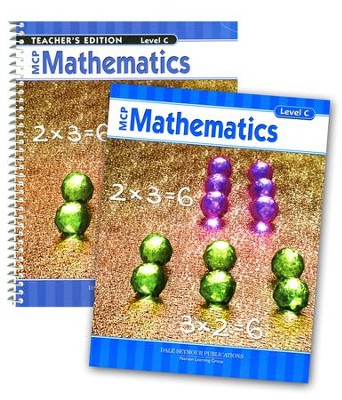
I also switched our "living" math to a curriculum. I wasn't doing such a hot job preparing the "living" lessons. Many times problems needed to be worked ahead of time and a lot of times I got those wrong. I wasn't comfortable teaching without a structured format and my children were getting frustrated with my own confusion over how to solve problems. I intended to return to Math Mammoth which we owned and used previously, but the flow of the lessons, the intermittent use of common core standards and lack of a teacher's guide turned me off. I searched through Cathy Duffy's reviews on math curriculum and found MCP Math.

MCP Mathematics Level C, Grade 3, 2005 Ed., Homeschool Kit   -
Cathy's description of the teacher's manual sold me instantly..
I sometimes use the MCP Mathematics teacher’s edition as an example of what a good teacher’s manual should look like. [...]

"I really appreciate this format where everything you might need is visible on a two-page spread. It is easy to pick out what you might want to use so lesson preparation time is minimal." cathyduffyreviews.com. 

Apparently one of the drawbacks to this curriculum is its lack of review and slow pace. Well I have Richele Baburina to thank for teaching me how to use the method of New, Review, and Mental math. It's a part of teaching math the living way.


There are plenty of problems in each section, more than could or should be done in one setting. I use the teacher's guide to "teach" the new part. I sit with my student as we work through the first few together. I then assign a few problems in the book for the student to work on independently.
I flag pages with a post it note that have problems I want to return to later for review, these problems are presented after their independent work is completed. In the teacher's manual there is a section on every page for warm-up, mental and review math. I use these exercises as a part of review or mental math. All in all, we spend about 30 minutes on math keeping the lessons short. 15 minutes on new, 10 minutes on review and the last 5 minutes on mental math. Lessons are still short and end on a lively note.

In spite of it being a curriculum, I'm still attempting to keep it lively and interesting. The kids seem to like it and they really like the fact I "look" like I know what I'm talking about.

I made a few other changes too, like dropping Spanish and Spanish folksong. I don't speak a foreign language and its been difficult for the children to pick up without any "immersion". I decided to hold off on Plutarch this year and I'm taking to the kids to an outside art class since that was always pushed to the back burner.

So there you go, our necessary changes to make this season more manageable. 

**updated planner pages uploaded under "Printables" tab